
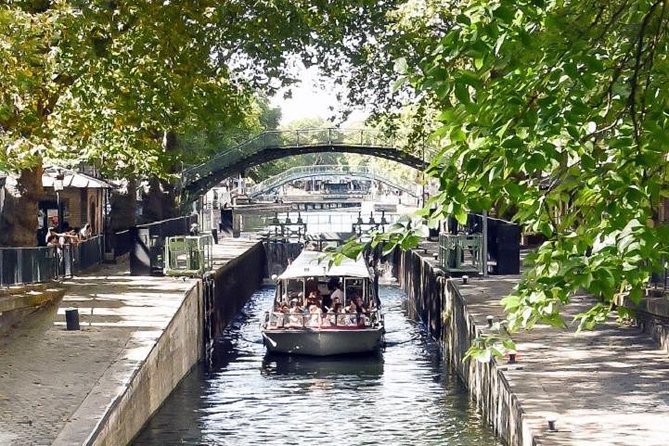
Reviewed · SEINE RIVER CRUISES
Paris: Cruise on The Canal Saint Martin and The Seine River
Paris changes fast from canal to classic Seine. This 2-hour cruise strings together Canal Saint-Martin surprises and big Seine River landmarks with live commentary in English.
I love how this is sightseeing without hours of walking. You move through Paris by water, so you get UNESCO-listed river views fast, and the boat keeps you in the right line of sight for photos.
I also love the storytelling. Reviews specifically praise guides like Lea and Ben for friendly, solid narration, and captain Pasquale for skilled handling, which matters when you’re watching locks, bridges, and riverside monuments.
One heads-up: the first half includes tunnel time, and on some days the sound mix and group noise can make it harder to hear clearly, especially upstairs in the heat.
In This Review
- Key things to know before you go
- Starting at Quai de Valmy, then slipping into Canal Saint-Martin
- Locks and the swing bridge: where you learn by watching
- The underground canal tunnel under Bastille: quiet where you expect noise
- Port de l’Arsenal: houseboats, marina life, then the Seine opens up
- The Seine from Île Saint-Louis toward Île de la Cité
- Pont des Arts, Pont Alexandre III, and the Left Bank icon parade
- Eiffel Tower moment at Trocadéro and Champ de Mars
- Crew and English narration: what to expect from the sound setup
- Getting off near Pont Neuf, then continuing on foot
- What this cruise is best for (and who should skip it)
- Should you book this Canal Saint-Martin and Seine cruise?
- FAQ
- How long is the Canal Saint-Martin and Seine cruise?
- Where does the cruise start and end?
- Is there English commentary?
- What happens if the weather is poor?
- How many people can be on the boat?
- When should I book?
Key things to know before you go
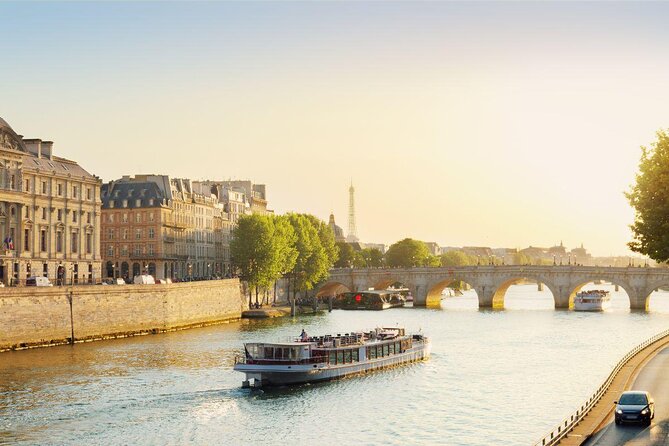
- Canal Saint-Martin locks and changing water levels up close, with a live feel for everyday canal life
- A long underground tunnel near Bastille, where the city noise drops off hard
- Boat-to-river transition at Port de l’Arsenal, where canal culture meets the Seine’s iconic sights
- UNESCO-listed Seine riverbanks with photo-friendly angles on Notre-Dame, the Louvre, and the Eiffel Tower
- Meeting at Quai de Valmy and finishing at Quai de l’Horloge near Pont Neuf, great for a smooth on-foot follow-up
- English narration is offered, but the audio can depend on crowd noise and where you stand
Starting at Quai de Valmy, then slipping into Canal Saint-Martin
You’ll begin at 73 Quai de Valmy in Paris, right where the Canal Saint-Martin district starts to feel like its own little world. The opening stretch is leafy and photo-ready, with trees along the water plus iron footbridges and waterside cafés that look like they belong to a stroll, not a cruise. Your guide sets the scene with how the canal was created to bring fresh water to Paris, and why this area later became a hangout for trendier neighborhood energy.
What makes this start work for your day is the rhythm. You get the canal’s calmer pace first, so the shift to the Seine later feels like a reward instead of whiplash. And because you’re on the water, you’re not stuck behind museum lines or dodging crowds just to get one good view.
I also like that early on you pass the Hôtel du Nord area, with its recognizable waterside vibe. It’s the kind of “wait, that’s right there” moment that makes the cruise feel more grounded than a generic sightseeing loop.
If you’re sensitive to heat, plan to manage it quickly. The canal portion is often where you’ll be looking outward and standing where the breeze is best, but it can still be warm, especially during summer departures.
More boats on the Seine, briefly compared
Locks and the swing bridge: where you learn by watching
After the opening canal stretch, the highlight comes: the lock passages. This is where the engineering becomes theater. You watch the gates open and close slowly, while the water level rises and falls around the boat. It’s not just visually cool. It helps you understand how Paris moves boats, supplies, and daily life through a city that isn’t naturally flat the way some waterways are.
One very practical tip: if you want the locks to be fully visible, don’t assume the best spot is always the very front of the upper deck. Some setups have people crowding near the front, and it can get hard to see the lower mechanics of what’s happening at the gates. If the boat’s configuration allows it, choose a position where you can see across the lock opening, not just straight ahead.
Then comes the swing bridge. Brief road traffic stops while the boat passes, and your guide explains how the canal operates, not just what you’re seeing. This is a good moment to pay attention, because bridges and locks are what make the canal feel like a working system rather than a scenic pond.
This portion tends to be the most talked-about in the reviews because it’s active and memorable. If you’re the type who likes photos, this is also when you’ll get dramatic framing: water level changes, ironwork close by, and city buildings pressing in on both sides.
The underground canal tunnel under Bastille: quiet where you expect noise
Next you enter the long underground tunnel beneath the Bastille area. The change of atmosphere is instant. The street sounds fade away and the boat moves in near-silence under vaulted stone, with daylight shafts breaking through overhead.
This segment is the main reason I think this cruise is better than a standard Seine-only boat ride. You’re getting a secret-feeling perspective on how the canal system threads through Paris, not just a lineup of famous landmarks. It’s surprising in the way that makes you stop looking at your phone and just watch what the tunnel does to the whole mood of the trip.
A key consideration: if you strongly prefer open views, the tunnel can feel like a slow stretch compared with the more scenic open-air parts. That’s especially true if you arrived expecting nonstop postcard scenery. You’ll still get the payoff afterward on the Seine, but mentally plan for a “we’re going inside the city” moment.
Also, keep in mind the sound situation can vary here. If the group gets loud or if the audio system is overwhelmed, the tunnel’s quiet can make it feel even more noticeable. If you’re after maximum narration, you might want to position yourself where you can hear cleanly when your guide speaks.
Port de l’Arsenal: houseboats, marina life, then the Seine opens up
When you emerge from the tunnel, the route connects to the Port de l’Arsenal, a marina basin linking Canal Saint-Martin to the Seine. This is a visual palate cleanser. Instead of stone above and water below, you get a more open harbor feel, with houseboats and pleasure craft moored around the basin.
Your guide explains how this former commercial port has been transformed into a pleasant harbor and garden. Even if you don’t normally care about ports and infrastructure, this stop matters because it’s where the cruise changes its personality from canal-world to river-world. The Seine is wider, the sights feel grander, and you’re finally in the zone where Paris looks like Paris.
It also helps you understand the scale of what you’re doing. You’re traveling from a networked canal system into one of Europe’s best-known river corridors. That transition is part of the value: you get two kinds of Paris in one ticket.
If you enjoy photos, this area often gives you better angles for capturing the boat’s movement with waterline reflections, plus a calmer background than the busiest landmark sections.
The Seine from Île Saint-Louis toward Île de la Cité
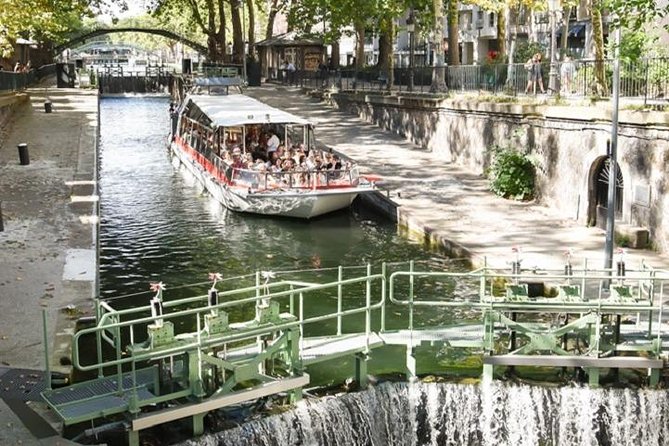
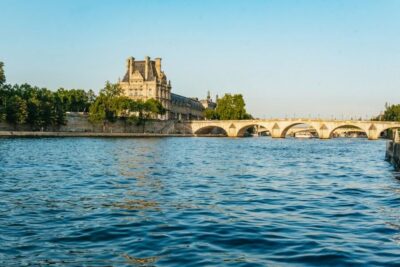
Once you join the Seine River, the scenery widens fast. You cruise alongside Île Saint-Louis with its elegant 17th-century façades, then you get a first strong look at Île de la Cité, the historic heart of Paris.
This is where the guide’s points help you connect the view to what you’ll recognize later on foot. From the boat, you can appreciate the river curve and the way bridges shape the city’s layout. Instead of seeing landmarks as isolated buildings, you see how they sit within a river geometry that’s been guiding life for centuries.
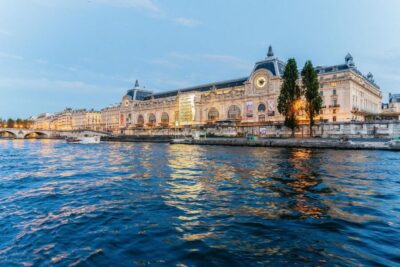
The route is also designed to keep famous icons in view without you needing to sprint between neighborhoods. You’ll pass major sites such as Notre-Dame Cathedral, the Conciergerie, the Louvre, the Tuileries gardens, and the Musée d’Orsay. And yes, the Eiffel Tower is in the mix too, so you’re not stuck waiting until the end for the big moment.
Why this part is valuable is simple: boat angles make it easier to frame buildings without the usual street-level interruptions. You can often get more coherent skyline shots here than from a crowded walkway.
One more practical point for your comfort: the Seine portion is outdoors on an open deck, which is great for photos and air flow, but it also means you’re exposed to sun. Bring sunscreen, and think about lightweight layers if the evening gets cooler.
Pont des Arts, Pont Alexandre III, and the Left Bank icon parade
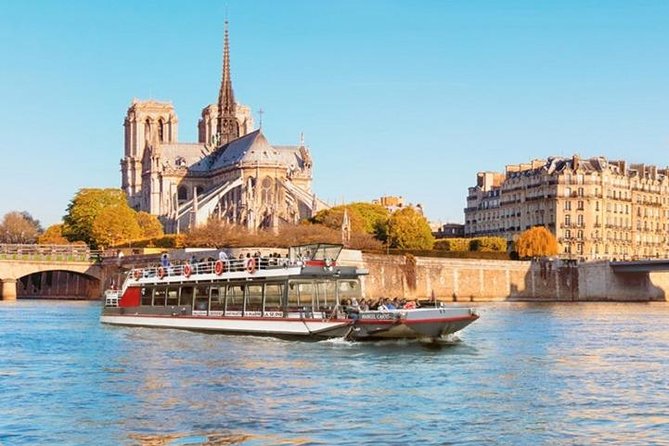
As you continue along the UNESCO-listed riverbanks, the cruise plays architectural highlight bingo in the best way. You pass the Hôtel de Ville (City Hall) and the riverside promenades where people actually do normal, everyday sitting and strolling. That local feel is a nice counterweight to all the big monuments.
Then the river gives you one of the best photo setups in the city: the Pont des Arts footbridge. From the water, you can get a viewpoint where multiple major buildings come into a single glance: the Louvre, and the domed Institut de France nearby on the Left Bank. It’s a “get it once, get it right” kind of viewpoint.
Next comes Pont Alexandre III, one of Paris’s most striking bridges, with golden statues and Art Nouveau lamps. If you’ve seen photos before, this is where it turns from poster image into real scale. You’ll also see the glass roof of the Grand Palais, and on the Left Bank the golden dome of Les Invalides, where Napoleon is buried.
If you care about architecture, this is a section where you’ll understand why people make a whole evening out of the Seine. The riverbanks are like an open-air corridor linking museums, palaces, and government buildings, and the boat keeps everything in motion so it doesn’t get boring.
Keep your expectations honest on sound, though. With larger groups, it can become hard to hear everything your guide says, especially if other passengers are talking. If narration matters to you, aim to stand or sit where your guide’s voice carries best.
More Paris hours afloat
- Paris: Evening River Cruise with Music
★ 4.4 · 22,721 reviews - Paris: Louvre Guided Tour with Reserved Access & Boat Cruise
★ 4.3 · 16,353 reviews - Paris: Big Bus Hop-On Hop-Off Tour with Optional Cruise
★ 4.4 · 13,279 reviews - Paris: Tootbus Hop-on Hop-off with optional river cruise
★ 4.3 · 11,924 reviews - Paris: Louvre Museum Entry Ticket With Host and River Cruise
★ 4.6 · 9,926 reviews
Eiffel Tower moment at Trocadéro and Champ de Mars
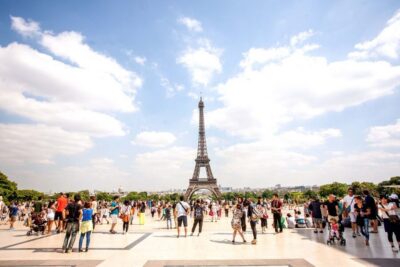
The cruise ultimately brings the Eiffel Tower into full view, towering above Trocadéro and Champ de Mars. This is the moment people wait for, and it’s a real one because you’re getting the tower in context with the river and the bridges, not just as an isolated shot.
The tour description also notes that in the evening the Eiffel Tower is lit up, and at the right time you can catch the sparkling lights. That’s a huge part of the emotional payoff. Even if you’re not traveling just for the photo, the light changes how the whole scene feels.
There’s also a practical advantage to getting here by boat. You can avoid some of the crush that happens when everyone tries to gather at the same sidewalk viewpoint. Here, you’re carried along, and your framing stays consistent.
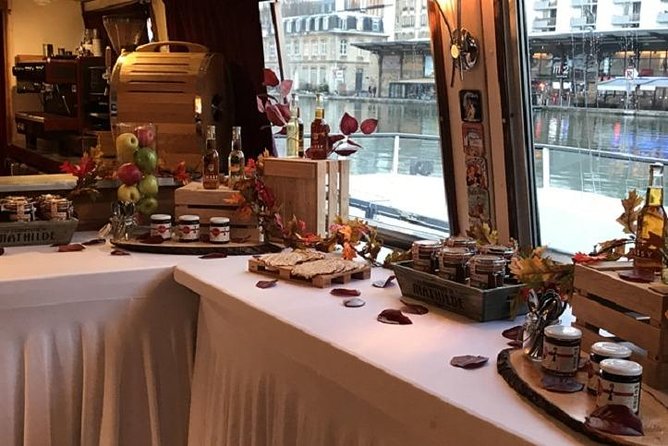
If you’re the kind of person who likes to celebrate, a few reviews mention a food or snack setup during the trip, and the boat has a concession stand for drinks such as soda, wine, and beer. If you want that comfort, this is one of the best times to grab something and settle in without missing landmark views.
Crew and English narration: what to expect from the sound setup
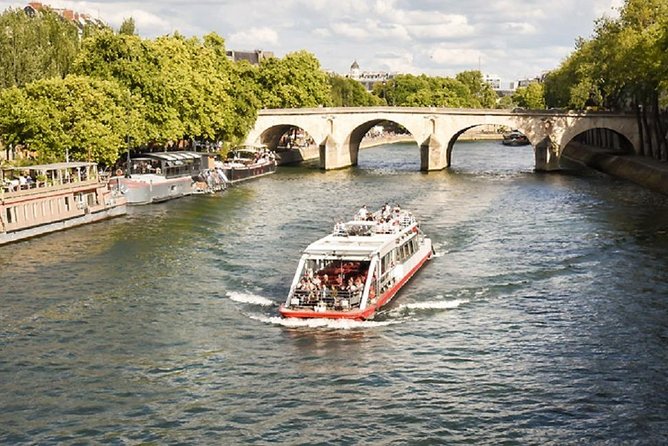
This cruise is sold as a live commentary experience, and that’s one of its biggest strengths. Reviews often praise guides such as Lea and Ben for being friendly and knowledgeable, with captain Pasquale described as skilled. That combination helps the canal engineering and Seine landmarks feel connected rather than like separate sightseeing segments.
But here’s the honest part: hearing the narration depends on two things you can control. First is where you stand. Second is crowd volume. Multiple reviews bring up hard-to-hear narration when the deck is crowded, kids are moving around, or people talk over the guide. Sometimes the issue is not the guide, it’s the sound system competing with real-life noise.
My advice if you really want the commentary:
- If there’s space, choose a spot where you can hear without leaning over a crowd.
- If the upper deck becomes noisy, consider switching to the lower area if your setup allows it.
- Arrive early enough to get situated calmly, so you’re not rushing into the loudest zone.
Also, the mix of languages matters. The tour is offered in English, but on some boats narration may include more than one language stream. If the guide changes cadence between languages, it can be harder to follow at speed. This is one reason to focus on the landmarks visually first, then let the commentary connect the dots.
Getting off near Pont Neuf, then continuing on foot
You finish at 19 Quai de l’Horloge on Île de la Cité, near Pont Neuf. This is a smart end point because it drops you right where you can keep exploring immediately. From here, it’s easy to walk into the Latin Quarter, cross toward the Right Bank, and choose your next stop.
If you want to use the cruise as a launchpad, you can pair it with a visit to Sainte-Chapelle. Or you can simply reset with a drink on a nearby terrace and let the day cool down.
One small logistical consideration: the end point includes steps and street-level access challenges that can be annoying if you use a walker or need low-friction routes. If that’s your situation, plan an easier walking path after you disembark.
What this cruise is best for (and who should skip it)
This is a strong choice if you want iconic Paris sights in a short window, but you don’t want to spend your energy sprinting between viewpoints. The canal locks and underground tunnel make it more interesting than a standard Seine cruise, and the UNESCO riverbank route keeps big monuments in play.
It’s also great for first-timers. You’ll see Notre-Dame, the Louvre area, the Orsay area, and the Eiffel Tower all in one flowing trip. Then you can decide later what to zoom in on while walking.
I’d be more cautious if:
- You hate enclosed spaces, because the tunnel is a major early segment.
- You get stressed by crowds or prefer very quiet guided commentary.
- You’re very heat-sensitive in summer, since the upper deck can get hot and standing can mean limited comfort.
Should you book this Canal Saint-Martin and Seine cruise?
Yes, book it if you want a high-value mix of working Paris waterways and Seine postcard landmarks without spending the whole day walking. The price for about 2 hours of live commentary, plus the unique Canal Saint-Martin locks and the underground tunnel, is hard to beat for first-time sightseeing.
I’d book with eyes open if you care most about open-air views from start to finish. The tunnel and locks come early, so you’re choosing variety, not a straight-line Seine sightseeing cruise.
If you can, pick a time that fits your comfort with sun and noise. Then arrive early enough to settle in. When you do that, this cruise can feel like one smart afternoon that sets you up for the rest of your Paris days.
FAQ
How long is the Canal Saint-Martin and Seine cruise?
The cruise runs about 2 hours.
Where does the cruise start and end?
It starts at 73 Quai de Valmy, 75010 Paris, and ends at 19 Quai de l’Horloge, 75001 Paris on Île de la Cité near Pont Neuf.
Is there English commentary?
Yes. The experience is offered in English, and it includes live commentary.
What happens if the weather is poor?
This experience requires good weather. If it’s canceled due to poor weather, you’ll be offered a different date or a full refund.
How many people can be on the boat?
The maximum group size is 100 travelers.
When should I book?
On average, this experience is booked about 23 days in advance.
More Paris Hours Afloat
- Paris: Evening River Cruise with Music
★ 4.4 · 22,721 reviews - Paris: Louvre Guided Tour with Reserved Access & Boat Cruise
★ 4.3 · 16,353 reviews - Paris: Big Bus Hop-On Hop-Off Tour with Optional Cruise
★ 4.4 · 13,279 reviews - Paris: Tootbus Hop-on Hop-off with optional river cruise
★ 4.3 · 11,924 reviews - Paris: Seine Cruise & Crepe Tasting near the Eiffel Tower
★ 4.4 · 11,231 reviews
The Whole Paris Shelf
- Paris: Louvre Museum Timed-Entrance Ticket
★ 4.6 · 71,977 reviews - Disneyland® Paris 1-Day Ticket
★ 4.6 · 49,412 reviews - Paris: Versailles Palace and Gardens Full Access Ticket
★ 4.6 · 41,579 reviews - Paris: Evening River Cruise with Music
★ 4.4 · 22,721 reviews - Paris: Eiffel Tower Entry Ticket with Optional Summit Access
★ 4.4 · 20,035 reviews
Still on the Seine
- Paris: Seine Cruise & Crepe Tasting near the Eiffel Tower
★ 4.4 · 11,231 reviews - Paris: Seine River Panoramic Views Dinner Cruise
★ 4.3 · 10,611 reviews - Paris: Eiffel Tower Access by Elevator & Seine River Cruise
★ 4.6 · 7,329 reviews - Paris: 3-Course-Dinner Cruise on the Seine with live music
★ 4.7 · 7,248 reviews - Bateaux Parisiens Seine River Gourmet Dinner & Sightseeing Cruise
★ 4.5 · 6,930 reviews
The rest of the Paris write-ups
- Montmartre: Guided Tour for Kids and Families★ 4.9 · 57 reviews
- From Paris: Versailles Palace and Gardens Guided Day Trip★ 4.5 · 57 reviews
- Versailles Palace and Garden Tour with Paris Private Transfers★ 5.0 · 58 reviews
- Louvre Evening Escape – Avoid The Crowds! Semi-Private 6ppl Max★ 5.0 · 58 reviews
- Summit Eiffel Tower Audio Guide Tour with Unlimited Time Access★ 4.5 · 58 reviews
- Private Half Day Historic Tour★ 5.0 · 58 reviews
Seine River Cruises, in full.
 ★ 4.4Paris: Seine Cruise & Crepe Tasting near the Eiffel TowerFrom $2311,231 reviews
 ★ 4.3Paris: Seine River Panoramic Views Dinner CruiseFrom $6410,611 reviews
 ★ 4.6Paris: Eiffel Tower Access by Elevator & Seine River CruiseFrom $797,329 reviews
 ★ 4.7Paris: 3-Course-Dinner Cruise on the Seine with live musicFrom $1357,248 reviews
 ★ 4.5Bateaux Parisiens Seine River Gourmet Dinner & Sightseeing CruiseFrom $1506,930 reviews
 ★ 4.4Paris: Hop-On Hop-Off Seine Cruise Pass with 9 StopsFrom $275,645 reviews
 ★ 4.2Paris: Seine River Bistronomic Dinner CruiseFrom $695,272 reviews
 ★ 4.3Paris : 3-Course Gourmet Dinner Cruise on Seine RiverFrom $1005,205 reviews
Also on these France lists