
Reviewed · PARIS VINTAGE CAR & SIDECAR TOURS
Private tour: visit Deauville in a sidecar
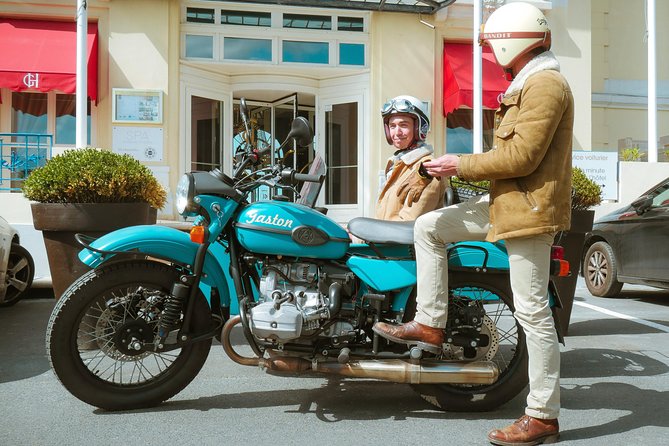
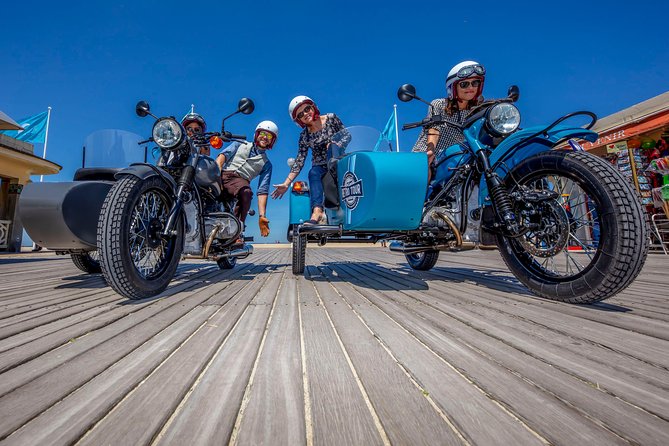
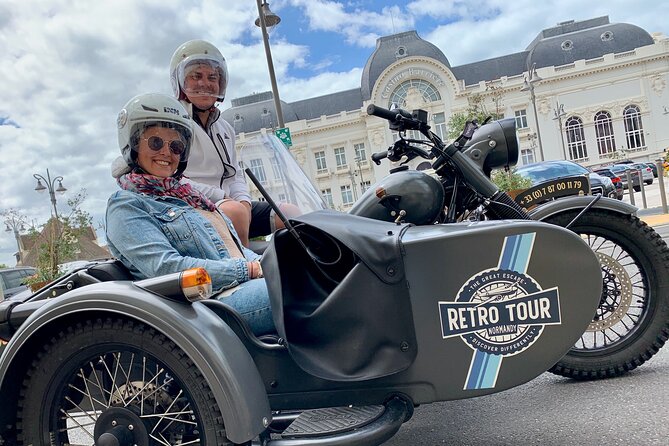
Sidecar time in Deauville is a ride. This private tour is geared for comfort and fun, with helmets and vintage goggles included, plus a local pilot who keeps the story moving.
What I liked most is the mix of places you do not usually see on a quick resort walk. I love the sidecar height, it makes the panoramic stops feel special fast, and I also love the pilot-style storytelling, part history, part humor, part local color.
The one drawback to know is that this is built for motion, not lingering. Plan on short stops and quick photos, and the experience really depends on good weather.
In This Review
- Key highlights you will feel during the ride
- Sidecars and safety gear: what passenger comfort really means
- Meeting in Deauville, then a fast 45-minute orientation loop
- The Barrière Le Normandy start: glamour from 1912 and a Poirot link
- Eglise Saint Augustin: the duke’s first stone, and planned-city Deauville
- La Touques racecourse: the four-season hippodrome in plain terms
- Villa Strassburger: Baron Henri de Rothschild and the Flaubert connection
- Church of St. Lawrence: a high stop with a real panorama
- Tourgéville Military Cemetery: quiet ground, heavy context
- Clairefontaine and the racecourse with 100,000 flowers idea
- Casino Barrière: baroque glamour and the Mesrine era
- Calvaire de la Corniche: the best view you can grab in minutes
- Price and value: why $84.69 can make sense for 45 minutes
- Who this Deauville sidecar tour fits best
- Should you book Retro Tour Normandy’s Deauville sidecar visit?
- FAQ
- How long is the Deauville sidecar tour?
- Is the tour private?
- What languages are offered?
- What is included in the price?
- How many people can be in a sidecar?
- What is the minimum age for passengers?
- Where does the tour start and end?
Key highlights you will feel during the ride
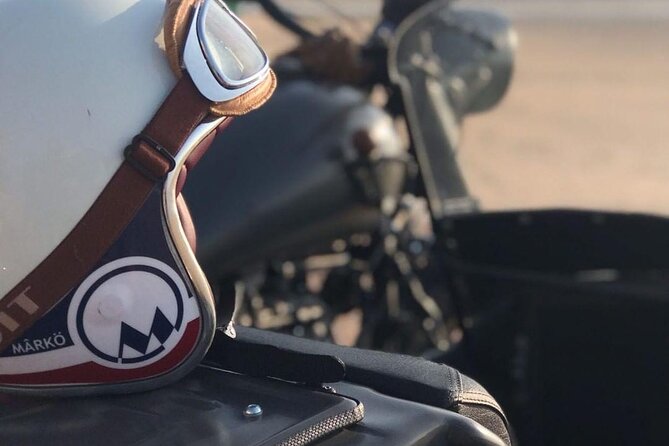
- Safety gear is part of the deal: helmets, gloves, vintage goggles, and rain gear
- Small-group private format: up to six people per booking, with a sidecar that fits two adults plus a small child
- A history-forward route: churches, racecourse landmarks, and a Commonwealth war cemetery
- Race and fashion energy: the pilot connects Deauville to racing culture, plus famous cultural references
- Viewpoints for photos: especially from high spots like St. Lawrence and Calvaire de la Corniche
Sidecars and safety gear: what passenger comfort really means
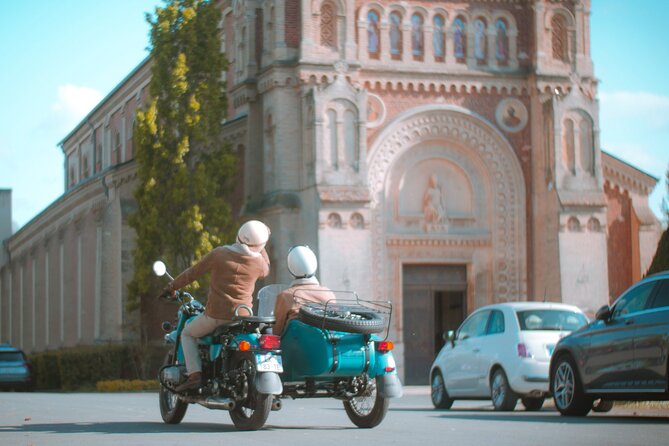
This is a private sidecar visit to Deauville, with helmets for everyone and extra gear that matters in Normandy: gloves, vintage goggles, and rain gear. That combination is practical. Helmets mean you can relax, goggles cut wind and grit, and rain gear helps if the sky changes.
Capacity is also clearly set: a sidecar can take two adults plus one small child. The setup is one passenger behind the pilot and one in the basket. Minimum age is 4, so it is family-friendly, but still “sidecar real,” not a stroller-and-cruising kind of outing.
One more comfort note: this kind of ride is short, about 45 minutes, so the motion is part of the charm. You might still want layers, because breezes happen when you are above street level, especially near viewpoints.
Meeting in Deauville, then a fast 45-minute orientation loop
You start at the Tourist Intercommunal Deauville on Quai de l’impératrice Eugénie, 14800 Deauville. From there, you get a quick loop designed to give you bearings in a compact amount of time.
Duration is listed as about 45 minutes, and the route is made of short stops. Several locations are timed around 5 to 10 minutes, so you get context, then you move on. That pacing is great for first-time visitors who want a “see it all once” overview without spending half the day.
The tour is offered in English, and you keep your group private. Maximum is six people per booking, so you are not blended into a large crowd. Also, a mobile ticket is used, which usually keeps things smooth once you arrive.
Weather does matter here. The experience requires good weather, and if conditions are poor, you are offered a different date or a full refund. So I treat this like a plan built for the day’s sky, not a flexible activity you want to rely on no matter what.
The Barrière Le Normandy start: glamour from 1912 and a Poirot link
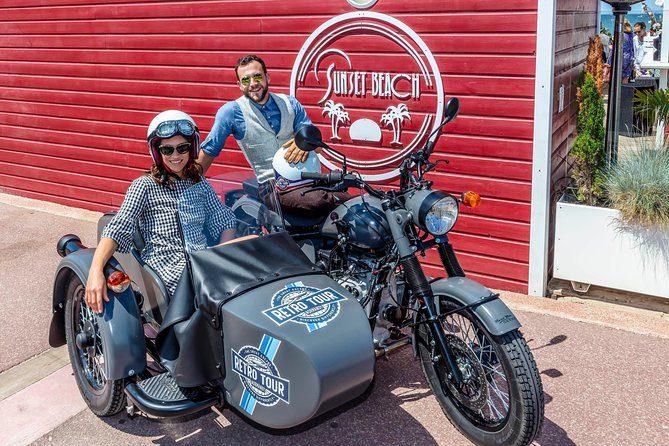
The ride begins at Hotel Barrière Le Normandy Deauville, a grand hotel that dates back to 1912, originally built as the Hôtel Normandy. It is part of the Groupe Lucien Barrière, and starting here sets the tone: Deauville is a resort city with high-style roots.
It also has a pop-culture claim that your pilot will likely weave into the bigger story. This hotel was used as a filming location for Agatha Christie’s Poirot, episode The Murder on the Links. Even if you are not a Poirot superfan, it is a fun anchor point because Deauville has always been a place where art, leisure, and architecture intersect.
Why start at the hotel: it is a clean “Deauville snapshot.” From here, you can understand the city’s identity before you hop to churches, racecourses, and the big-view stops that come later.
Eglise Saint Augustin: the duke’s first stone, and planned-city Deauville
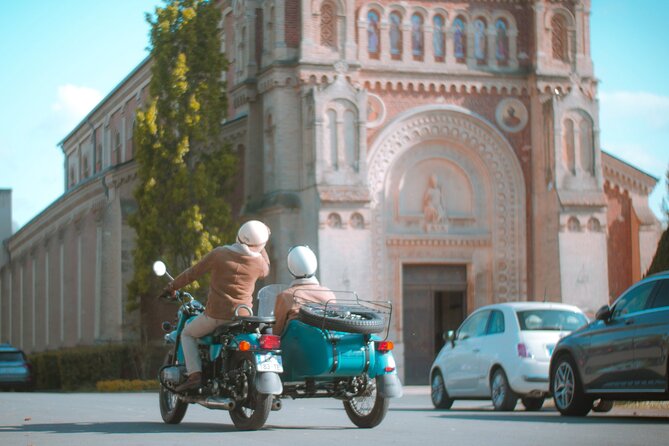
One of the quickest stops is Eglise Saint Augustin, but the history lands. On August 30, 1864, the Duke of Morny laid the first stone. The land had been acquired just nine days earlier, and the church was built on a walled garden setting.
Architects credited here are Desle-François Breney and Anatole Jal. It was blessed on July 30, 1865 by the bishop of Bayeux. The cemetery sits outside the original city borders, on the heights of Mont Canisy.
In a short stop, you can miss the meaning if you just walk and take pictures. The value is that your pilot can connect the dots: Deauville was not only a seaside retreat, it was also a planned new city that shaped its identity through institutions like churches.
La Touques racecourse: the four-season hippodrome in plain terms
The route then leans hard into racing culture at Hippodrome Deauville La Touques. This racecourse gets the nickname “four season hippodrome” because it works across seasons, not just summer.
The calendar includes 42 days exclusively dedicated to flat races. The training center is also part of the story, with room for about 300 horses in winter and 600 in summer. Group 1 races and high-level international involvement bring serious energy here.
A practical detail that makes the “four seasons” idea real: Touques was the first racecourse to add a sand-fibre track, so racing can happen even when fields around Normandy are snow-covered. Turf returns when the weather turns friendlier.
Your pilot will likely mention major races tied to Deauville’s racing identity, including Prix Rothschild, Maurice de Gheest, Jacques Le Marois, Morny, Jean Romanet, and the Grand Prix de Deauville. Even if you are not a racing person, this stop helps you see why the city grew the way it did.
Villa Strassburger: Baron Henri de Rothschild and the Flaubert connection
Next up is Villa Strassburger, protected as a historical monument since 1975. This imposing mansion connects Deauville to two big names in one narrative thread: Baron Henri de Rothschild and Gustave Flaubert.
The commission came from Baron Henri de Rothschild, who loved racing and chose to settle near the racetrack. The villa was erected in 1907 at the location of the Coteau Farm, property associated with the family of Gustave Flaubert.
There is also a real-world access detail: the villa is visited from June to September and by appointment, and it can be rented for private events. On this sidecar tour, you are there briefly, so the point is appreciation and context, not a long interior visit.
The drawback to keep in mind: if you are hoping for a full look inside, this route is not built for that. You are getting the exterior impact and the story that explains why the building matters.
Church of St. Lawrence: a high stop with a real panorama
Church of St. Lawrence is placed on the heights of Deauville, overlooking the city. That location is the whole reason this stop works well on a sidecar tour.
Even in just 10 minutes, you get that shift from street level to viewpoint. Your pilot’s commentary helps too, because the significance of a viewpoint is easier to grasp when you know what you are looking at. Expect the kind of framing that helps you understand the city layout, not just scenery.
This is also one of the best moments for photos from above. People tend to leave this kind of stop with a few keepers, because Deauville’s style looks better when you can see the geometry of streets and the way the city opens outward.
Tourgéville Military Cemetery: quiet ground, heavy context
Then you reach Tourgéville Military Cemetery, created in 1918. This is one of the most meaningful stops on the route, and it deserves a different pace than sightseeing.
The cemetery is owned by the Commonwealth War Graves Commission, with extraordinary maintenance. France granted a permanent concession at the end of the war, and the British cemetery of Tourgéville was inaugurated in 1920. Initially, it was intended for soldiers who died in British Army hospitals established in Trouville-Deauville.
The reason this stop belongs on a short sidecar tour is not dramatic spectacle. It is context. Deauville and nearby resorts were close to key wartime movement and medical facilities, and this cemetery gives you a tangible link.
If you are photographing, keep it respectful. This is the kind of place where the best souvenir is a moment of silence, then moving on with the day’s perspective changed.
Clairefontaine and the racecourse with 100,000 flowers idea
The tour also includes racecourse architecture at Clairefontaine. The venue is described as designed by architects Jean Papet and André Rimbert. Papet is connected to several houses in Neuilly-sur-Seine, while Rimbert is noted for designing stands and a racecourse at Maisons-Laffitte.
Clairefontaine is a Norman-style racecourse, combining concrete and half-timbering. What really feeds the local identity is the emphasis on flowers decorating the façades. The place was nicknamed “racecourse with 100,000 flowers” around 50 years ago by Léon Zitrone.
On a sidecar, this kind of detail is easier to catch than when you walk past quickly. You still should not expect a long stop, but you do get the look and the explanation that turns an exterior into something memorable.
Casino Barrière: baroque glamour and the Mesrine era
Another highlight is the Casino, built in 1912. The casino was designed by architect Georges Wybo, and it was inaugurated on July 11, 1912, commissioned by Eugène Cornuché. The same operator also inaugurated the casino of Trouville-sur-Mer a few days earlier.
Then comes the restoration story. In 1988, it was completely restored in baroque style by Jacques Garcia. If you care about architecture, this is a good moment to connect Deauville’s resort image with the building’s later makeover.
For a darker chapter, the casino is tied to the attack on May 26, 1978, attributed to Jacques Mesrine and François Besse. Your pilot will likely keep it factual and move quickly, but it still adds contrast to the glamour vibe.
Calvaire de la Corniche: the best view you can grab in minutes
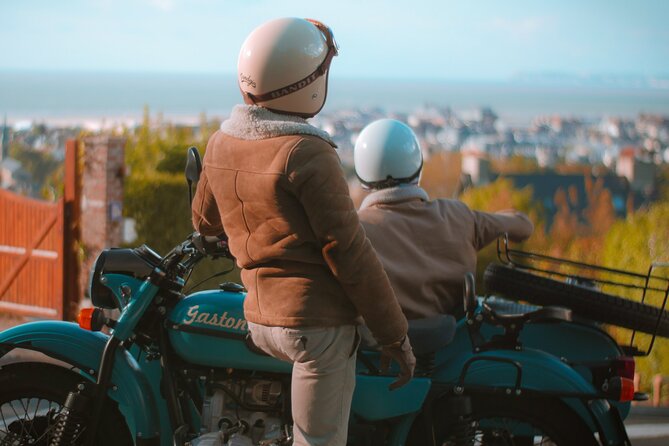
The ride ends with a viewpoint at Calvaire de la Corniche, often described as the most beautiful view of Trouville. This stop is short, about 5 minutes, but it is timed for payoff.
This is exactly where sidecar format shines. You are high, you are moving, and then you stop just long enough to orient your eyes and snap photos before you roll again.
If you want a “Deauville postcard angle,” this is the moment to use your camera and let the pilot point out what you are seeing. Past riders have specifically called out photo-friendly viewpoints from the ride’s height, and Calvaire is the kind of stop that delivers that outcome.
Price and value: why $84.69 can make sense for 45 minutes
At $84.69 per person for about 45 minutes, it is not a budget activity. But value here is not only time. It is access to a very specific experience: a private sidecar ride with a guide who adds context at multiple landmark stops.
You also get practical inclusions that reduce the hassle of planning for weather. Helmets, gloves, vintage goggles, and rain gear are included. That matters in Normandy, where conditions can shift quickly.
You also have small group advantages. With a maximum of six people per booking, you are more likely to get personal attention than on a large bus-style tour. If you are traveling as a couple, or a small family with a child in the eligible age range, you can spread the experience cost across a tight group and make it feel less like a one-off splurge.
The main value tradeoff: it is short and focused on highlights, not extended time at any single site. You are paying for motion plus narration, not for museum hours or long interior access.
Also note what is not included: food and drinks. If you are doing this in the middle of the day, I suggest planning a nearby snack and water option before or after the ride.
Who this Deauville sidecar tour fits best
This tour fits best if you:
- are in Deauville for a short stay and want quick orientation
- like quirky transport that is still practical, with safety gear included
- enjoy racing culture, architecture, and viewpoint moments
- want a family outing with a child aged 4+
- appreciate a guide who tells stories and connects the dots, from fashion and film references to historic context
You might want to choose something else if you:
- want long museum-style visits or long time inside buildings
- dislike any motion-based sightseeing and prefer to stay on foot in one area
- are planning around uncertain weather and cannot be flexible
Should you book Retro Tour Normandy’s Deauville sidecar visit?
I would book it if you want a compact, high-impact way to see Deauville’s big themes: elegant hotel culture, church history, racing landmarks, a war cemetery stop with real meaning, and the kind of views that make you stop and look.
Pass if you need slow pacing, long indoor time, or you are not able to match your schedule to good weather. And because this is popular enough to average around 18 days in advance, I recommend booking earlier rather than assuming you can grab it last minute.
FAQ
How long is the Deauville sidecar tour?
It lasts about 45 minutes.
Is the tour private?
Yes, it is a private tour/activity, so only your group participates.
What languages are offered?
The tour is offered in English.
What is included in the price?
It includes helmets, gloves, vintage goggles, rain gear, and anecdotes.
How many people can be in a sidecar?
A sidecar can accommodate up to two adults plus one small child, and there is room for 1 to 2 passengers per sidecar.
What is the minimum age for passengers?
The minimum age is 4 years old.
Where does the tour start and end?
It starts at Tourist Intercommunal Deauville, Quai de l’impératrice Eugénie, 14800 Deauville, France, and ends back at the same meeting point.
Paris Vintage Car & Sidecar Tours, in full.
 ★ 4.6Paris: Discover Paris by Night in a Vintage Car with a LocalFrom $811,058 reviews
 ★ 5.0Paris Private Flexible Duration Guided Tour on a Vintage SidecarFrom $119776 reviews
 ★ 4.9Lille Driving Tour by Convertible Citroen 2CVFrom $34711 reviews
 ★ 4.5Vintage 2CV Adventure: 2 -Hour Paris Secrets TourFrom $344488 reviews
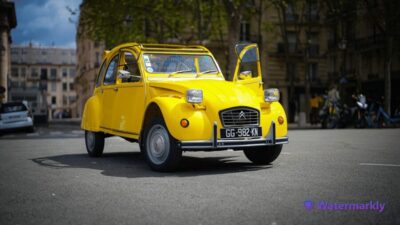 ★ 4.9Paris: Discover Paris 2CVFrom $135472 reviews
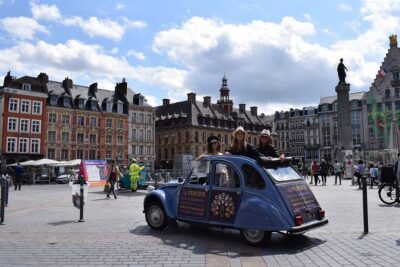 ★ 5.0Unique Tour of Lille by Convertible 2CV – 1h00From $54470 reviews
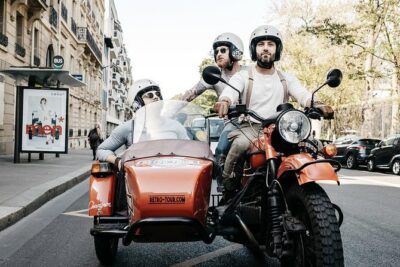 ★ 5.0Paris Vintage Private City Tour on a Sidecar MotorcycleFrom $171417 reviews
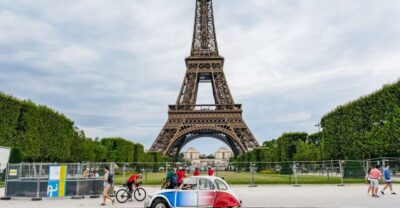 ★ 4.7Paris: 1-Hour Vintage Citroen 2CV TourFrom $64314 reviews
Also on these France lists