
Reviewed · LOUVRE MUSEUM TOURS
Guided tour of the Louvre Museum with tickets included
The Louvre can feel like a maze. This guided, small-group visit turns it into a clear route, with skip-the-line entry and art history context that makes famous works easier to read. You also get a practical pace aimed at seeing the Louvre’s biggest names without getting lost in the scale.
I especially love how Matteo Allavena connects masterpieces to what came before and what came after, like the jump from Greek ideals to the drama of Romanticism. I also like the tight focus on must-see stops, from the Tanis Sphinx to the Mona Lisa area, plus standout rooms devoted to Napoleon and revolutionary paintings. One consideration: at about 2 hours, you will see major highlights, but you will still want extra time later if you love slow, unhurried wandering.
In This Review
- Key points to know before you go
- Why a 2-hour guided Louvre plan beats winging it
- Getting in at Le Café Marly and starting with confidence
- What you actually pay for: price, ticket value, and the guide
- Medieval Louvre to the Tanis Sphinx: start old, then build momentum
- Greek department stops: Athena, Venus de Milo, and Victory
- Galerie Apollon and the Grande Galerie: when the building becomes part of the show
- Giotto and the stigmata scene: Italian painting with a story you can use
- Classicism to Romanticism: Napoleon’s world to Delacroix’s revolution
- Pacing, group size, and how to get the most out of 2 hours
- Who should book this Louvre tour, and who might prefer something else
- The one thing to watch for
- Should you book this Louvre guided tour?
- FAQ
- How long is the Louvre guided tour?
- What language is the tour offered in?
- Is the entrance fee included?
- Does the tour include skip-the-line access?
- Where is the meeting point?
- How many people are in the group?
- Is a service animal allowed?
- Who can participate?
- Is there free admission for some visitors?
- Can I get a refund if I cancel?
Key points to know before you go

- Skip long lines fast so you lose less time in Paris heat and crowd pressure
- Small group size (max 6), which makes it easier to ask questions and stay on track
- A guided route through major departments from medieval spaces to Greek, Italian, and 1800s masterpieces
- Specific showstoppers included like Venus de Milo, Victory of Samothrace, Giotto, and the Mona Lisa
- Napoleon and Romanticism in one flow so you can spot shifts in style and politics quickly
Why a 2-hour guided Louvre plan beats winging it
The Louvre is huge. Even if you think you know what you want to see, you can burn a lot of time just deciding where to go next. This tour solves that problem with a focused path and just enough structure to keep the museum from swallowing your day.
I like that the visit is built around big, recognizable works, but also around the logic of how the collection is organized. That means you are not only collecting famous names. You are learning how different periods look at power, religion, myth, and revolution.
It is also a smart choice for travel days where you have limited time. You get a guided sweep that helps you feel oriented, then you can spend your remaining time browsing on your own with a much better sense of direction.
Other ways into the Louvre, compared
Getting in at Le Café Marly and starting with confidence

You meet at Le Café Marly, 93 Rue de Rivoli, 75001 Paris. The tour ends back at the meeting point, so you are not stuck figuring out what to do when it is over.
This matters more than people think. The Louvre area can be chaotic, and finding the right meeting point can add stress right before you start. My advice: have your confirmation details handy and arrive a few minutes early, especially if you are traveling with a family or with anyone who needs extra time.
Once you are in, the tour includes entrance tickets and skip-the-line access. That is where the biggest value usually shows up. The Louvre can be physically draining, and line time is the worst kind of time waste.
What you actually pay for: price, ticket value, and the guide
The price is $114.93 per person, and the entrance fee included is 28 euros, with skip-the-line entry. So your money is mostly going toward the guide, the time-saving access, and the targeted route that makes two hours feel like more.
Here is the honest way to think about the cost. If you are the type who wants to study artwork on your own with a guidebook, you might do fine without paying for a tour. But if you want context fast, plus a plan that prevents you from wandering aimlessly, this kind of guided highlight visit is often worth it.
Reviews for this tour put the focus on how the guide explains what you are looking at, not just where things are. That is the difference between seeing objects and actually understanding how they fit together.
Medieval Louvre to the Tanis Sphinx: start old, then build momentum
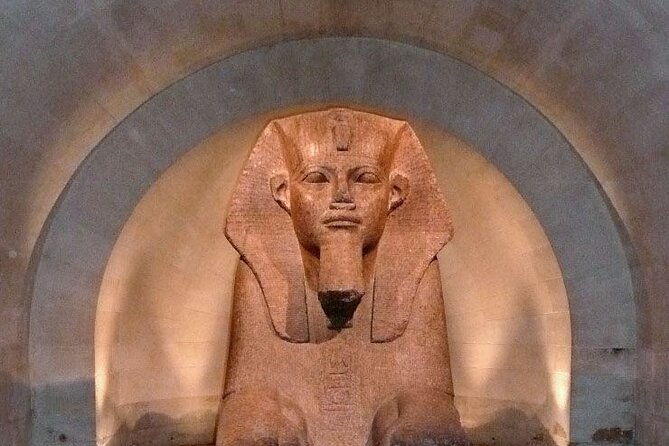
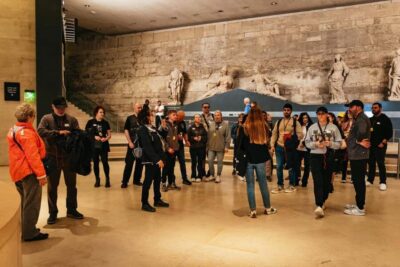
The tour begins with the Medieval Louvre, including the 13th-century walls. This is a great opener because it reminds you that the Louvre was not born as a gallery of art icons. It started as a fortress, and that background changes how you read the building.
Then comes the Tanis Sphinx, described as a 4000-year-old sphinx. Even if you only know it as a “cool ancient thing,” your guide can help you notice the details that make it historically powerful. The early placement also helps you settle in. Instead of walking straight into the most crowded rooms, you start with a sense of scale and age.
Why this section works: it gives you perspective. When you later see the classical Greek sculptures and the famous paintings, you will understand that the museum is not a single story. It is many stories layered into one place.
Greek department stops: Athena, Venus de Milo, and Victory
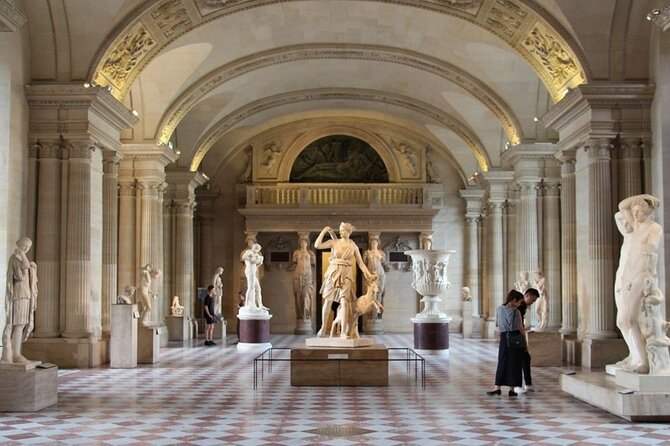
Next you move through the Greek department, with stops that include Athena of Velletrie, Venus de Milo, and Victory of Samothrace.
These are the kinds of works that draw attention even when you think you are not “an art person.” But seeing them without context can make it feel like a checklist. With a guide, you can slow down just enough to notice what makes the sculptures influential: posture, movement, and how the artists shaped ideals of beauty and power.
A practical tip: in Greece-themed rooms, your eyes will want to sprint from one masterpiece to the next. Let your guide steer the order, because that order helps you compare. You start to feel the shift from static beauty to action, which is exactly what makes Victory so unforgettable.
Galerie Apollon and the Grande Galerie: when the building becomes part of the show

Then you enter two spaces that help the Louvre make sense. First is Galerie Apollon, known here as the finest piece that inspired Versailles. This is not just an architectural flex. It is a shortcut to understanding how French taste and power used art and space together.
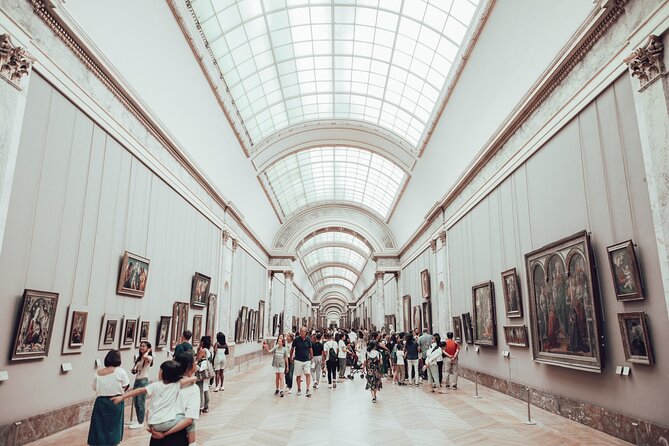
After that, the tour spends time in the Grande Galerie. This is where scale becomes part of the experience. Your guide points you toward works you might miss if you were just looking for one famous name at a time, including Guirlandao’s L’enfant et l’ancien, Veronese’s Les noces de Cana, and Leonardo da Vinci’s Mona Lisa.
If you have ever looked at the Mona Lisa crowd from outside, you know how hard it can be to get a real look. Having a guide helps here because the route is meant to get you to the right area efficiently, and the context makes your visit more than a photo moment.
One consideration: the Mona Lisa area is always busy. You should expect that. What you can control is how long you spend trying to “figure it out.” This tour is built so you spend less time stuck and more time actually seeing.
More Paris tours that come with a guide
- Paris: Louvre Guided Tour with Reserved Access & Boat Cruise
★ 4.3 · 16,353 reviews - Louvre Museum Masterpieces Guided Tour with Access
★ 4.5 · 12,023 reviews - Louvre Museum – Exclusive Guided Tour (Entry Included)
★ 5.0 · 6,296 reviews - Louvre Priority Access with Mona Lisa Escort or Guided Option
★ 4.0 · 4,420 reviews - Louvre Museum: Skip-the-Line Small Group Guided Tour
★ 4.6 · 3,960 reviews
Giotto and the stigmata scene: Italian painting with a story you can use
Next up is Italian painting of the Middle Ages, with the stop on Saint Francis receiving the stigmata by Giotto.
I like this part because it shifts you from sculpture and space into painting with a clear narrative hook. When you know the religious and symbolic background, the gestures in the scene stop looking like generic medieval drama. They start looking intentional.
This is also a useful mental break in a long museum day. You are still in the Louvre, but the kind of looking changes. It becomes less about matching shapes to famous images and more about following meaning through small, precise details.
Classicism to Romanticism: Napoleon’s world to Delacroix’s revolution

The tour finishes with two rooms that help you spot big changes in style and message.
In the Classicism room, you see The Coronation of Napoleon and Leonidas at Thermopylae by Jacques Louis David. Classicism tends to push order, heroism, and a clear sense of power. These works help you understand how artists used the language of antiquity to support the politics of their own era.
Then the tour moves to the Romanticism room, including Géricault’s Raft of the Medusa and Eugène Delacroix’s Liberty Guiding the People. Romanticism, at least in this set of rooms, feels more urgent. It leans into emotion, chaos, and political energy rather than calm ideals.
Why I think this ending works well: it leaves you with a framework. After you see Classicism and Romanticism back-to-back, you will start recognizing the mood of a painting before you read the label. That is a win in a museum as vast as the Louvre.
Pacing, group size, and how to get the most out of 2 hours
This tour caps at 6 travelers, and that small size shows in the feel. You are not stuck as part of a moving crowd that never pauses. The guide can slow down when questions pop up, which many people appreciate, especially if you are visiting with kids or you just like to ask why something looks the way it does.
The tour is also designed to be time-efficient. Expect a guided rhythm that hits major highlights without turning the visit into a long lecture. Reviews for this experience strongly emphasize that the tour is organized and paced well, with a focus on both well-known icons and some less obvious choices.
Practical advice for you: decide ahead of time what you want most. If you love Greek sculpture, you will get a strong dose here. If you care about French art politics, you will like the Napoleon and Romanticism rooms. If you care about everything, that is fine too, but prepare for a sprint. Bring water if you can before or after the tour, since coffee and food are not included.
Who should book this Louvre tour, and who might prefer something else
This is a strong fit if:
- You have limited time and want the Louvre’s most famous works, plus smart context
- You want skip-the-line entry to reduce the chance of your day turning into queue management
- You like the idea of a guided path that keeps you from getting overwhelmed
You might choose a different style of tour if:
- You want to spend hours parked in one room doing slow, deep looking
- You already know the Louvre thoroughly and just need free time to wander
Also, check timing. The tour is commonly booked about 57 days in advance, and the Louvre does not get easier as the day gets later. If you are aiming for a specific time window, I would not treat it like a last-minute option.
The one thing to watch for
Most tours go smoothly, but any timed experience can have hiccups. One review described an issue where the guide did not proceed as expected due to a booking situation, even though a refund and line-skipping were offered. The takeaway for you is simple: do not book last minute if having a guided visit is your main goal.
When in doubt, arrive early, confirm your meeting details, and keep your expectations realistic for a museum that is always busy.
Should you book this Louvre guided tour?
Yes, if you want a high-impact, guided highlights tour that makes the Louvre feel navigable and meaningful. The combination of skip-the-line access, a small group, and an art history narrative focused on major turning points from ancient to 1800s is a good value use of your time.
If you are traveling with limited time or you fear the museum will overwhelm you, this type of route is exactly what helps. You will leave with better connections between artworks, not just photos, and you will be in a much stronger position to enjoy the rest of the museum on your own.
FAQ
How long is the Louvre guided tour?
The tour lasts about 2 hours.
What language is the tour offered in?
The tour is offered in English.
Is the entrance fee included?
Yes. The entrance ticket is included (28 euros).
Does the tour include skip-the-line access?
Yes. Skip the line is included.
Where is the meeting point?
You meet at Le Café Marly, 93 Rue de Rivoli, 75001 Paris, France.
How many people are in the group?
This tour has a maximum of 6 travelers.
Is a service animal allowed?
Yes, service animals are allowed.
Who can participate?
Most travelers can participate.
Is there free admission for some visitors?
Free admission applies to visitors under 18 and EEA residents under 26, as long as you present valid ID and proof of residency.
Can I get a refund if I cancel?
You can cancel for a full refund if you cancel at least 24 hours before the experience start time. If you cancel less than 24 hours before, the amount paid is not refunded.
Everything Else Filed Under Paris
- Paris: Louvre Guided Tour with Reserved Access & Boat Cruise
★ 4.3 · 16,353 reviews - Paris: Big Bus Hop-On Hop-Off Tour with Optional Cruise
★ 4.4 · 13,279 reviews - Louvre Museum Masterpieces Guided Tour with Access
★ 4.5 · 12,023 reviews - Versailles: Skip-the-Line Tour of Palace with Gardens Access
★ 4.7 · 9,778 reviews - Mona Lisa & Louvre Masterpieces Tour with Reserved Access
★ 4.6 · 6,812 reviews
The Whole Paris Shelf
- Paris: Louvre Museum Timed-Entrance Ticket
★ 4.6 · 71,977 reviews - Disneyland® Paris 1-Day Ticket
★ 4.6 · 49,412 reviews - Paris: Versailles Palace and Gardens Full Access Ticket
★ 4.6 · 41,579 reviews - Paris: Evening River Cruise with Music
★ 4.4 · 22,721 reviews - Paris: Eiffel Tower Entry Ticket with Optional Summit Access
★ 4.4 · 20,035 reviews
The Louvre, More Ways In
- Paris: Louvre Museum Timed-Entrance Ticket
★ 4.6 · 71,977 reviews - Paris: Louvre Guided Tour with Reserved Access & Boat Cruise
★ 4.3 · 16,353 reviews - Louvre Museum Masterpieces Guided Tour with Access
★ 4.5 · 12,023 reviews - Paris: Louvre Museum Entry Ticket With Host and River Cruise
★ 4.6 · 9,926 reviews - Paris: Priority Access Louvre with Host -Direct to Mona Lisa
★ 4.1 · 8,387 reviews
The rest of the Paris write-ups
- Montmartre: Guided Tour for Kids and Families★ 4.9 · 57 reviews
- From Paris: Versailles Palace and Gardens Guided Day Trip★ 4.5 · 57 reviews
- Versailles Palace and Garden Tour with Paris Private Transfers★ 5.0 · 58 reviews
- Louvre Evening Escape – Avoid The Crowds! Semi-Private 6ppl Max★ 5.0 · 58 reviews
- Summit Eiffel Tower Audio Guide Tour with Unlimited Time Access★ 4.5 · 58 reviews
- Private Half Day Historic Tour★ 5.0 · 58 reviews
Louvre Museum Tours, in full.
 ★ 4.6Paris: Louvre Museum Timed-Entrance TicketFrom $2671,977 reviews
 ★ 4.3Paris: Louvre Guided Tour with Reserved Access & Boat CruiseFrom $8116,353 reviews
 ★ 4.5Louvre Museum Masterpieces Guided Tour with AccessFrom $8612,023 reviews
 ★ 4.6Paris: Louvre Museum Entry Ticket With Host and River CruiseFrom $1009,926 reviews
 ★ 4.1Paris: Priority Access Louvre with Host -Direct to Mona LisaFrom $748,387 reviews
 ★ 4.6Mona Lisa & Louvre Masterpieces Tour with Reserved AccessFrom $806,812 reviews
 ★ 5.0Louvre Museum – Exclusive Guided Tour (Entry Included)From $1816,296 reviews
 ★ 4.0Paris: Louvre Reserved Ticket and River Cruise ComboFrom $376,054 reviews
Also on these France lists